
How to Play Mine Logic Puzzles: Read the Numbers, No Guessing
In a mine logic puzzle, you open every square that doesn’t hide a mine without touching one. A number on an open square counts the mines in the 8 squares around it. Comparing it with the closed squares nearby shows which are mines and which are safe; you flag the sure mines, though flags aren’t needed to win.
Published
Rules: Numbers, Flags and Digging
The field is a grid of closed squares, and some of them hide mines. This kind of puzzle is often called minesweeper. When you dig a square, you either hit a mine and lose, or you see a number.
- The number shows how many mines are in the 8 squares around that square: horizontal, vertical and diagonal. A 3 means 3 of the neighbors hold a mine. A blank square has no mines around it, and its neighbors open by themselves.
- To read a number, compare it with the closed squares and flags around it: the number minus the flags is how many mines it still needs.
- Edges and corners: A corner square has 3 neighbors and an edge square has 5, so keep the board’s edge in mind.
- A flag marks a square you’re sure holds a mine. It reminds you not to dig it by accident, and you can remove it later.
- The total number of mines is known from the start. Near the end, counting the remaining mines can solve a spot the numbers can’t.
- To win, opening every non-mine square is enough; flags are optional. To lose, you only have to open a single mine.
At the start you have no information, so your first dig is partly luck. Some games guarantee a safe first square; the real puzzle begins after that.
Your First Dig and First Numbers
In this 6×6 field from Crystal Field (where crystals stand in for mines), we dug the square in row 3, column 3, near the center. It was blank, its neighbors opened, and the opening spread in a chain until 25 of the 36 squares were open. The 1s and 2s along the edge of the open area are the real clues.
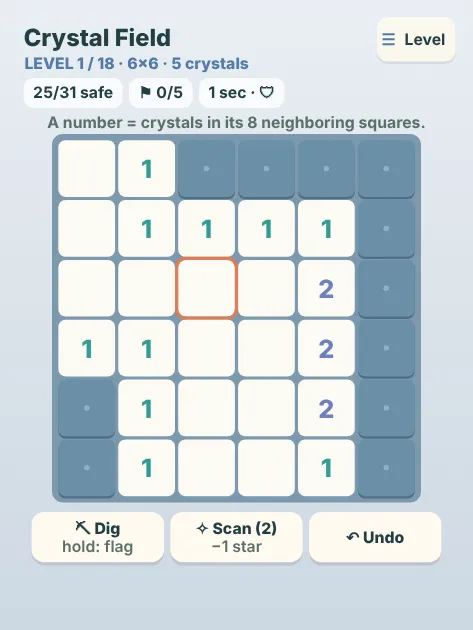
Rule 1: If a number equals the count of closed squares around it, all of them are mines. The 1 in the second square of row 1 has only 1 closed neighbor, the third square of row 1: a mine. Likewise, the first 1 in row 4 has only 1 closed neighbor, the first square of row 5: another mine.
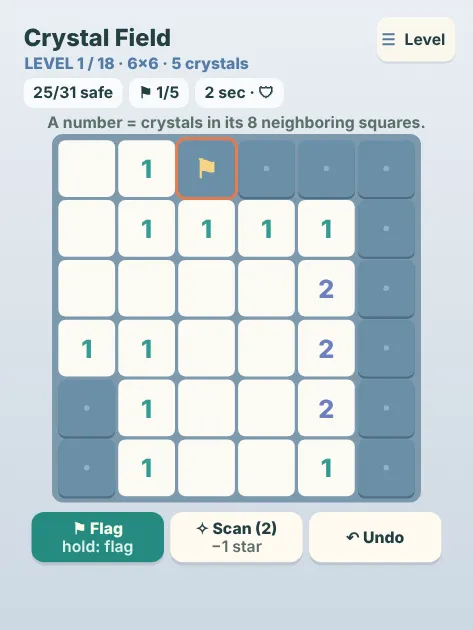
The reverse of rule 1: Once you’ve flagged all the mines around a number, its other closed neighbors are safe, so open them. The counter at the top shows how many flags you’ve placed.
The second column from the right holds 3 squares that show a 2. Each has 3 closed neighbors, so they tell you nothing yet; the subset rule below solves them. Blank squares are surrounded by open squares, so information comes from the numbers along the edges of blank areas.
Strategy and Tips
- Rule 1 first. Check every number: if it has as many closed neighbors as its value, they’re all mines. After you flag them, reread the numbers around them; if a number’s mines are complete, its remaining neighbors are safe.
- Then the subset (difference) rule. If one number’s closed neighbors all lie inside another’s, the difference between the 2 numbers is the number of mines in the squares left over. A difference of 0 means those squares are safe; a difference equal to their count means they’re all mines.
- Example. In the field above, a 2 sits directly above a 1 at the bottom of the second column from the right. The 1 in row 6 has 2 closed neighbors on its right; the 2 above it has those same 2 squares plus the last square of row 4. So 2 − 1 = 1 mine, and it must be in the extra square: the last one in row 4.
- When you’re stuck, move to another area. Each newly opened square shortens the closed-square lists of nearby numbers, which often unlocks a stuck spot.
- A random field can still force a guess. With randomly placed mines, you can end up with 2 squares left, 1 holding a mine, and no number says which; logic stops there. Rule 1 and the naked single in sudoku rest on the same logic: both say “if no other option remains, the result is certain.” The sudoku guide shows the same thinking.
How Crystal Field Differs from the Classic Version
Crystal Field puts crystals where the mines would be; the rules are the same. The differences:
- No-guess fields. The crystals are placed after your first dig. The game tries to solve each layout with just 2 rules (rule 1 and the subset rule), and it throws away a layout it cannot solve and sets up a new one.
- A safe first dig. The first square you dig and the 8 squares around it are always safe (at an edge or in a corner, that means all of its neighbors), so your first dig always opens a blank square.
- Shield. The shield forgives 1 mistake in the first 3 levels: the first crystal you touch doesn’t end the level, and the square gets flagged.
- Scan. The ✧ Scan button opens a safe square for you after your first dig: 2 scans in levels 1–12 and 1 in levels 13–18. Finishing without scans and within the time target gives 3 stars; each scan costs a star.
- Tap to open. Tap a number whose flags are complete and the closed squares around it open together. The number of flags is capped at the number of crystals. Undo reverses digs, flags and chain openings.
- Fields. Levels 1–6 are 6×6 (5–7 crystals), levels 7–18 are 7×7 (8–13 crystals), and the Daily field is 7×7 with 12 crystals. A flag is either there or not: no question marks, no custom sizes.
Frequently asked questions
What do the numbers mean?
A number tells you how many of the 8 squares around an open square hold a mine: a 1 means 1 mine nearby, a 3 means 3. A blank square means no mines around it, and its neighbors open by themselves.
Can your first dig hit a crystal?
It depends on the game: some guarantee a safe first square and others don’t. In Crystal Field, it can’t. The first square you dig and the 8 squares around it are always safe, and the crystals are placed after that first tap.
Can every field be solved without guessing?
Not every random field. Sometimes 1 of the last 2 squares holds a mine and no number says which. Crystal Field tries to solve the field with 2 rules as it places the crystals and discards a layout it can’t solve, so its fields need no guessing.
What is the subset rule?
If one number’s closed neighbors lie inside another’s, the difference between the numbers is the number of mines in the left-over squares. Example: a 1 has 2 closed neighbors, the 2 beside it has 3, and the first 2 are the same squares. The third square holds 2 − 1 = 1 mine.
Games related to this guide
Sudoku Steps
Small squares, perfect order.
2–5 min (9×9: 5–15 min) · Play free
Pixel Tapestry
From numbers to pictures.
2–5 min · Play free
Hidden Fleet
A silent duel against the admirals.
2–5 min · Play free