
How to Solve Sudoku: Step-by-Step Techniques from 4×4 to 9×9
Sudoku is a puzzle where you fill the empty squares so that every number appears once in each row, column and box. A well-made sudoku has exactly 1 solution. Just 2 techniques get you started: if only 1 number fits in a square, write it in (a naked single); if a number has only 1 spot left, put it there (a hidden single). Below, we apply both to a 4×4 board, step by step.
Published
Sudoku Rules: Rows, Columns and Boxes
Sudoku is played on a square board. Thick lines divide it into boxes: 9 boxes of 3×3 squares on a 9×9 board, 6 boxes that are 3 squares wide and 2 tall on a 6×6 board, and 4 boxes of 2×2 squares on a 4×4 board. Some squares start filled in. These are the clues, and you can’t change them.
There is just 1 rule: every number from 1 to the board’s side length appears exactly once in each row, column and box, so 1–4 on a 4×4 board, 1–6 on 6×6 and 1–9 on 9×9. Let’s call a row, column or box a unit. A number can’t go into a square if one of its units already has it.
Example: if a row on a 4×4 board has 1, 2 and 4, its empty square can only be a 3. The numbers that can still go into a square are its candidates. Solving means ruling out candidates until each square has just 1 left.
The bigger the board, the more candidates: at most 4 per square on 4×4, at most 9 on 9×9. That’s why it’s good to learn on a small board; the same methods work on a big one.
The board is solved when no square is empty and no unit repeats a number. Easy boards need no guessing, and the 2 methods in this guide solve them.
Your First Board: Naked Singles and Hidden Singles
Level 1 of Sudoku Steps is a 4×4 board with 9 of its 16 squares filled in. Let’s try both methods on it.
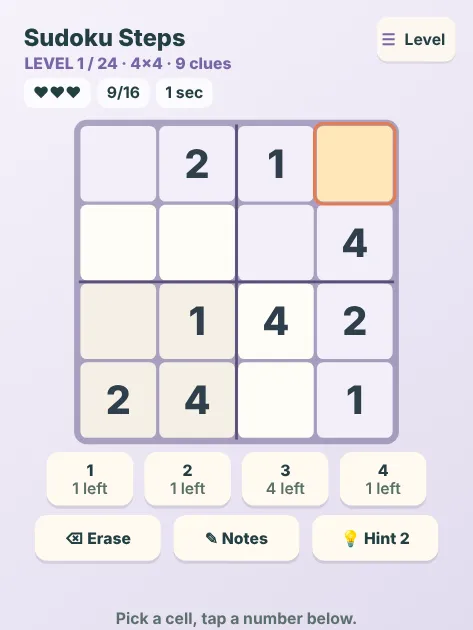
Naked single: If only 1 number fits in a square, write it in. In the figure, the selected square is the last one in row 1. Its row has 1 and 2, its column has 1, 2 and 4, so only 3 is left.
Keep going the same way:
- Row 1, column 4: only 3 fits. Write it in.
- Row 3, column 1: its row has 1, 4 and 2, which leaves 3.
- Row 4, column 3: its row has 2, 4 and 1, which leaves 3.
- Row 2, column 2: its column has 2, 1 and 4, which leaves 3.
- The last 3 squares are easy now. Row 1, column 1: the row has 2, 1 and 3, so it’s 4. Row 2, column 1: the column has 4, 3 and 2, so it’s 1. The last square, row 2, column 3, gets the 2.
Hidden single: If a number has only 1 spot left in a row, column or box, write it there. Look at row 2 on the same board: the 1 fits only in the first square. The fourth square holds the 4, and columns 2 and 3 already have a 1.
Strategy and Tips
- Start where the board is fullest. A row, column or box with few empty squares has few candidates, and the solution usually opens up there.
- Start with the number that appears most. The more often a number is on the board, the easier its remaining spots are to find. On 9×9, the last spot of a number that appears 8 times is obvious.
- Scan number by number. Pick a number and rule out the rows, columns and boxes that already contain it. If 1 spot is left, write it in; if not, move to the next number. After a full pass, a new spot often shows up.
- Use notes. Pencil in the candidates of an unsure square; they make a number’s only spot or a square’s only candidate easier to see. When you place a number, erase it from the notes in its row, column and box.
- Don’t guess. A wrong guess ruins the whole board. If you’re stuck, scan again from the start: one row, one column and one box at a time, number by number.
- Look at advanced techniques, but don’t rush. Pairs and X-wings come up in hard newspaper puzzles. Sudoku Steps boards are solved with naked and hidden singles alone, so you don’t need them there; if you’re stuck, you may have missed a number or written a wrong one.
To try the same kind of reasoning on another puzzle, see the mine logic puzzles guide, which shows how to draw certain conclusions from numbers.
How Sudoku Steps Differs from Classic Sudoku
Sudoku Steps is built to teach these 2 methods one step at a time:
- Growing boards. Levels 1–4 are 4×4, levels 5–24 are 6×6 and levels 25–36 are classic 9×9. The first 9×9 level (level 25) is open from the start. The Daily board is 6×6 and starts with 12 clues.
- Guess-free boards. Each board is made by removing clues one at a time, for as long as it can still be solved with naked and hidden singles. That’s why every board has a single solution.
- Instant feedback. A wrong number turns red and costs 1 life; 3 mistakes end the level. On paper you spot an error late, but here you see it right away.
- Limited help. Each board gives you 2 hints, and the Hint button fills in a square with the right number for you. Finish with no mistakes and no hints for 3 stars; 1 mistake or 1 hint leaves 2 stars, and any more leaves 1.
- Automatic note cleanup. A number you place correctly is erased from the notes in the same row, column and box.
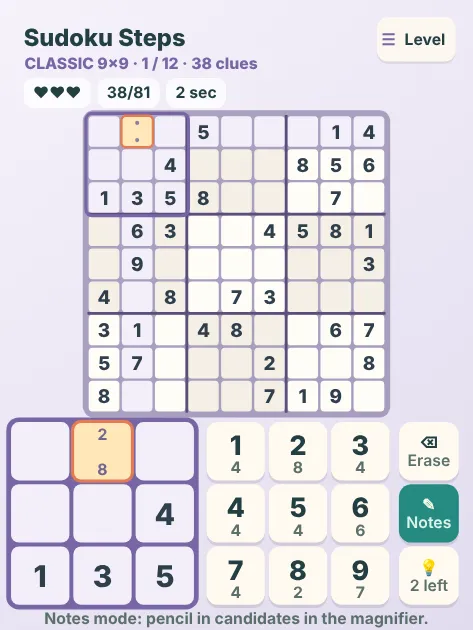
- A magnifier on 9×9. The box you select is enlarged in a separate magnifier, and the number keys show how many of each digit are left.
- What’s missing: diagonal and killer sudoku.
Frequently asked questions
Do you ever have to guess in sudoku?
Not on easy boards: naked and hidden singles are enough. Harder boards may call for advanced techniques such as pairs. Every Sudoku Steps board is solved with the first 2 methods alone, so none needs a guess.
How is 6×6 sudoku different?
The rule is the same, but the numbers are 1–6 and the boxes are 3 squares wide and 2 tall. With fewer squares, there are fewer candidates, so 6×6 is a good step for practicing before 9×9. In Sudoku Steps, levels 5–24 are 6×6.
What are notes for?
A note is a small pencil mark for a square’s candidates. Notes save you from searching for the same number again and help you spot a number’s last spot. In Sudoku Steps, while the ✎ Notes button is on, a number you enter becomes a note instead of going on the board, and it costs no life.
Can a sudoku have more than one solution?
It can, but such a board isn’t considered well made: with too few clues, more than one way of filling it in fits the rules. Sudoku Steps boards are built by removing clues while keeping them solvable with naked and hidden singles, so each has a single solution.
Games related to this guide
Pixel Tapestry
From numbers to pictures.
2–5 min · Play free
Crystal Field
Don’t guess; read the clues.
2–5 min · Play free