
Sea Battle Game Rules and Winning Strategy: How to Find the Fleet
In a sea battle game, the goal is to sink every ship in your opponent’s hidden fleet before yours goes down. The two sides take turns calling a square and hear “miss”, “hit” or “you sank it”. Random firing won’t cut it: search in a checkerboard pattern, then probe the neighbors after a hit to sink the ship. Below are the rules, search strategies and how Hidden Fleet differs from the classic game.
Published
Rules: a hidden fleet, shots in turn
In the classic game each player has a hidden grid and a fleet. Ships sit on the grid horizontally or vertically, and your opponent doesn’t know where.
- Grid and fleet: The classic game is played on a 10×10 grid and each player usually has five ships (5, 4, 3, 3 and 2 squares long).
- Firing: You take turns calling a square. Your opponent answers “miss”, “hit” or “you sank it”.
- Sinking: A ship sinks once every one of its squares has been hit.
- Winning: Whoever sinks all of the opponent’s ships first wins.
- Placement: In most versions ships may sit side by side; in some they may not touch. Lining ships along edges or repeating a layout gives clues; random placement is safer.
The first sunk ship: what to do after a hit
In sea 1 shown (6×6, three ships of 3, 2 and 2 squares), six shots have been fired. The third shot was a hit. When the squares above and below it came up empty, the square to its left was tried: a second hit, and the 2-square ship sank. The squares around it were then marked automatically; no other ship can be there.
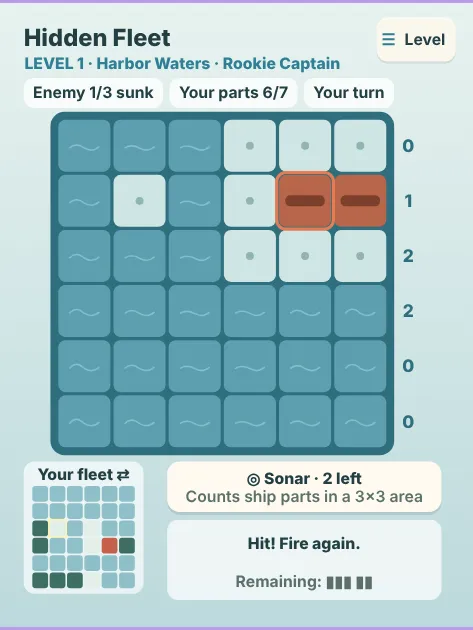
On this sea the numbers on the right edge help too: each number tells you how many ship parts are left in that row that haven’t been hit. Rows showing 0 hold no ships, so aiming your first shots at the other three rows halves the search area. In the figure, the first three shots all went into one of those rows. Every hit turns the search local; once the ship sinks, that information is spent and you return to the general sweep.
Winning strategies
- Search in a checkerboard pattern. The smallest ship is 2 squares long, so if you fire at every other square (like a checkerboard) you’ll run into every ship at least once, and the number of squares to search is cut in half. In Hidden Fleet, the Hunter Captain searches this way.
- Probe the neighbors after a hit. Try the squares above, below, left and right of the hit. If two hits sit side by side, the ship lies along that line; try both ends.
- Widen the gaps to match the remaining ships. Once the smallest ship is sunk, if only ships of 3 or more are left, you can fire at every third square.
- Work out the odds. The number of ways the remaining ships could cover a square is its value: middle squares fit many placements, edges and corners fewer. The Tactical Admiral and the Grand Admiral do a similar calculation on every shot.
- Track your shots and results. Keep in view which squares were misses and which were hits; probing the same square twice wastes a shot. Hidden Fleet warns you if you tap a square you already know.
- Don’t leave a ship half-sunk. Fire elsewhere before sinking a ship you’ve hit and you mix up which square belongs to which ship. Finish it first, then resume searching.
- Don’t skip the edges. Ships can sit against the edge, so scan the edge squares in the checkerboard pattern too.
- Don’t probe around a sunk ship. In nhuu ships never touch, so no other ship sits right beside one; the game marks those squares anyway, so don’t spend shots on them.
How Hidden Fleet differs from the classic
Hidden Fleet turns the classic duel into a 12-sea campaign:
- Small seas. The first four seas are 6×6; from sea 5 on, the grid is 7×7. The fleet starts at three ships of 3, 2 and 2 squares in sea 1 and grows to four ships of 5, 4, 3 and 2 squares in the last sea. You don’t place the ships; both fleets are laid out at random.
- Ships never touch. Ships are placed so they never touch, and when a ship sinks, the squares around it are marked automatically.
- Streaks. A hit earns another shot, and a miss passes the turn to your rival. In the classic game each turn is one shot; here a hit keeps the turn.
- Row counts. In sea 1, next to each row, the number of ship parts left in that row is shown.
- Sonar. Sonar tells you the number of unhit ship parts in the 3×3 area around the square you tap. You get 1 or 2 uses depending on the sea, and sonar uses up your turn: you can’t fire on the turn you use it, and the turn passes to your rival. So use it where you know the least, not at random.
- Stars. When you win, you earn 3 stars if 70% of your fleet is still afloat and 2 stars if 40% is.
- Four rivals. The Rookie Captain mostly fires at random. The Hunter Captain searches in a checkerboard pattern and tries the neighbors after a hit. The Tactical Admiral and the Grand Admiral fire using a probability map, and the Grand Admiral uses sonar as well.
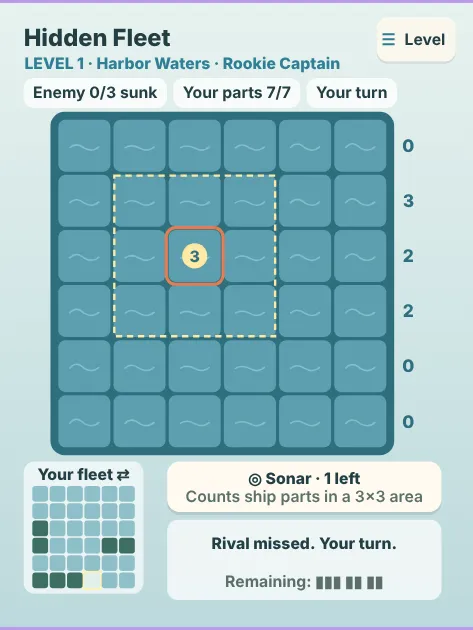
In the figure, sonar was placed on row 3, column 3 and counted 3 ship parts in the 3×3 area. The row counts already tell you the ships sit only in rows 2, 3 and 4; the sonar adds that 3 of the 7 parts in total lie inside those squares.
Frequently asked questions
Where should you fire first in a sea battle game?
You have no information at first, so sweep every other square, like the same-colored squares of a checkerboard. Starting in the middle makes sense too, since middle squares fit more placements.
What do you do after a hit in a sea battle game?
Try the squares above, below, left and right of the hit. If two hits sit side by side, the ship lies along that line, so try both ends. When the ship sinks, go back to searching in the checkerboard pattern.
Does sonar use up your turn in Hidden Fleet?
Yes. Sonar is used instead of a shot, it uses up your turn and the turn passes to your rival. It tells you the number of unhit ship parts in a 3×3 area, and you get 1 or 2 uses depending on the sea.
Can ships sit side by side in Hidden Fleet?
No, ships are placed so they never touch. When a ship sinks, the squares around it are marked automatically, so you don’t need to spend shots on them.
Games related to this guide
Line of Four
Get four in a row.
2–5 min · Play free
Knight’s Route
Every L opens a new path.
2–5 min · Play free
Isle Alliance
Grow, connect, unite the archipelago.
2–5 min · Play free