
How to Win Four in a Row: Center, Threats and Fork Tactics
In four in a row, two players take turns dropping discs into an upright board of 7 columns and 6 rows; the first to line up four of their discs horizontally, vertically or diagonally wins. Three keys: hold the center column, spot and block your opponent’s threats, and build a fork, a threat your opponent can’t block in two places at once. Below are the rules, the tactics and how Line of Four differs from the classic game.
Published
Rules: gravity and four discs
The board stands upright. A disc dropped into a column falls to its lowest empty square, so that is always the square you can play.
- The board: The classic board is 7 columns and 6 rows, 42 squares in all.
- Turns: Two players take turns dropping one disc. The discs are different colors (usually red and yellow).
- Winning: Whoever lines up four of their discs side by side, horizontally, vertically or diagonally, wins. The board holds 69 different fours.
- A full column: You can’t drop a disc into a full column; once columns fill, you run out of squares to play. In Line of Four, tapping a full column shows a “Column full” warning.
- A draw: If all 42 squares fill with no four, it’s a draw.
- The first move: Moving first is an advantage; who starts is agreed or decided by a coin toss.
How to read a threat: a stack and a marker
In the game shown you face the first rival, Apprentice Ada, and each side has dropped 9 discs. Your rival (ivory) has stacked three in the left column; a fourth on top makes four, which is why the square above is marked “!” and the game says “Watch out: rival can win!”. The marker appears in the first four matches.
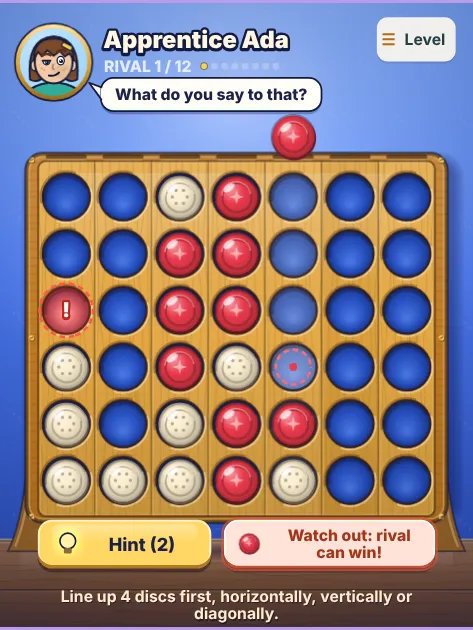
Even without a marker you should see it yourself: after every move, check whether your opponent can win next move. If they can, block that square; if you have a square you can win on, use it first. In this example the marked square is playable right now, so a single disc closes the threat. The marker only shows a direct threat for the next move; a fork two moves away you have to foresee yourself.
Winning tactics
- Hold the center column. Squares in the center column belong to the most fours: a square in the middle of that column is part of 13 different fours, while a corner square is in only 3. All four horizontal fours pass through it. If you move first, start in the center column.
- A solved game. Four in a row has been solved by computer: if both sides play perfectly, the first player who starts in the center column wins, and a player who starts in the columns nearer the edge loses that advantage. In real games, mistakes decide.
- Look for threats after every move. Spot the square where your opponent could win on their next move and block it. Check your own winning squares on every turn too.
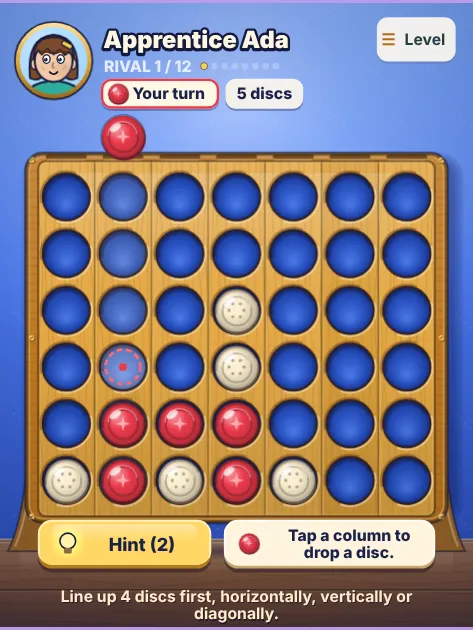
- Build an open-ended three. If both ends of a horizontal three are playable (the squares below them are filled), your opponent can block only one, and you win on the other. The second figure below shows exactly this.
- Build a fork. A threat to win on two separate squares at once is called a fork; your opponent can’t block both. You usually prepare it with single threats: build a three that forces a reply, then open the second direction.
- Don’t forget the diagonals. Your eyes scan horizontal and vertical lines most, and diagonal threes often get built unnoticed. Check all four directions every move.
- Fill columns evenly. If you fill a column fast, your squares to play dwindle; late in the game, with no harmless move left, you may have to play beneath your opponent’s threat square.
- Don’t play under your opponent’s threat square. If you drop a disc right below the square where your opponent would win, you open that square up for them.
- Advanced: odd and even rows. Threats on odd rows counted from the bottom tend to be worth more to the player who moves first, and threats on even rows to the player who moves second. It’s a rule of thumb, not a rule.
How Line of Four differs from the classic
Line of Four keeps the classic rules and comes with two modes:
- 12 matches vs the computer. You play two matches each against six rivals (from Apprentice Ada to Legend Demir), and you and your rival take turns moving first. The rival is a search engine that looks further ahead as the rivals get stronger: the last one looks 8 moves ahead. It also rewards discs in the middle column, so that column matters to your rival too.
- Threat marker. In the first four matches, the square where your rival would win on its next move is marked; after that there’s no marker, and you read the threats yourself.
- Hints. When you play the computer you have 2 hints; a hint suggests a column.
- Stars. For 3 stars you have to win without hints and with at most 10 discs.
- Two-player mode. Two people can play on one device; this mode has no AI, hints or threat markers. Scores are kept only when you play the computer.
In the figure, red (you) has lined up three discs in the second row from the bottom, in columns 2, 3 and 4. The squares on the left and the right are playable, because the squares beneath them are filled. Whichever one your rival blocks, you win on the other: this is an open-ended three. A strong rival would have stopped this earlier; it came up in match 1, against Apprentice Ada.
Frequently asked questions
Where should you play first in four in a row?
In the center column. Its squares belong to the most fours and let you build lines reaching both sides of the board. The game has been solved by computer, and a first player who starts in the center and plays correctly wins.
Does the first player win in four in a row?
With perfect play, yes: the first player who starts in the center wins. But in real games both sides make mistakes; the second player can win too by blocking threats and building a fork.
What is a fork in four in a row?
It’s a threat to win on two separate squares at once. Your opponent can block only one per move, so you complete four on the other. A horizontal three with both ends playable is the easiest example.
How many hints can you use in Line of Four?
You have 2 hints against the computer; two-player mode has none, nor threat markers. For 3 stars, win without hints and with at most 10 discs.
Games related to this guide

Hidden Fleet
A silent duel against the admirals.
2–5 min · Play free
Knight’s Route
Every L opens a new path.
2–5 min · Play free
Disc Flip
Hold the corners, tip the balance.
2–5 min · Play free