
Snake Game Tips: How to Get a High Score by Managing Space
The secret to a high score in a snake game isn’t speed, it’s managing empty space. The goal is to collect food without hitting a wall or your own body, and since the snake grows with every bite, the board shrinks and your own body becomes the biggest obstacle. Below are the rules, space-management tactics and where Spark Snake departs from the classic game.
Published
Rules: food, growth, collisions
A snake game is played on a grid. The snake never stops: it moves one square every step, and you only control its direction. The goal is to collect the food that appears and grow as long as you can.
- Food: When the snake reaches the food it grows by one segment, your score goes up and new food appears on another empty square.
- Collisions: Hit your own body and the run is over. The wall rule varies: in some versions the snake leaves one edge and re-enters from the opposite one; in others walls kill too.
- No reversing: You can’t turn back the way you came; you can go straight, or turn left or right.
- Speed and score: In many versions the snake speeds up as it eats and your score grows with the food you collect, so every bite raises both the score and the risk.
- Ending: Fill the whole grid and you win. In practice almost every run ends in a collision; the aim is to delay it.
How a run goes: the first five bites
In the run shown, the snake has collected five sparks and grown to 9 segments. Its body sits in an L shape in the bottom right corner, and the new spark is at the far end of the board, bottom left. The first reflex is the shortest path, but a good player first looks at where they’ll end up after the bite. Here the snake can turn left, run along the upper side of its body and drop down once the body ends.
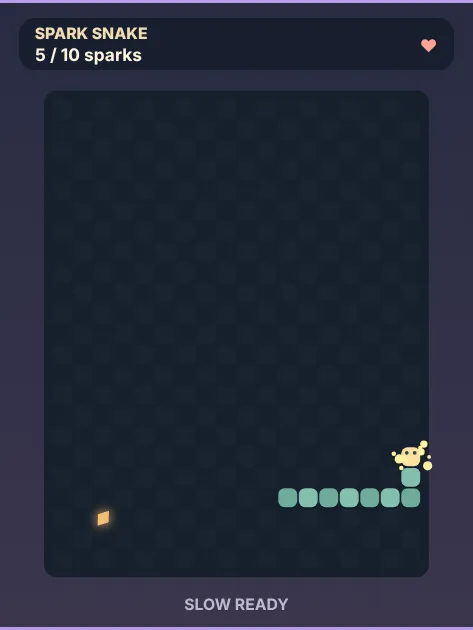
So before every bite, ask two questions: how do I get there, and where do I come out afterwards? The spark is near the bottom edge; once you take it the snake hugs that edge and one direction is closed from the start. The longer the snake gets, the less free space is left, so a corner that looks comfortable today can become a trap a few bites later.
Strategy and tips
- Stay away from edges and corners. Along a wall one direction is already closed; in a corner, two are. Even when the food is on the edge, approach it from one square inside.
- Exit first, food second. Before you go for food, think three steps past it. If your own body blocks both sides of the food, leave it for now; another lap beats crashing.
- Switch to a lane pattern when you’re long. Fold your body row by row (right along one row, left along the next) and you won’t leave pockets where it can lock itself in. Food won’t always land on the pattern; break the lane to grab it, then return.
- Follow your own tail. The tail pulls back one square every step, so tracking it is a safe path. In Spark Snake you can step onto the square your tail is leaving; only on the step where you eat does the tail stay put, and stepping there is a crash.
- A safe loop through the whole board exists. The board is 18×23 and 18 is even, so a closed path can visit every square once and return to the start. Follow it and the snake never traps itself, but food doesn’t lie on the path, so you give up bonus time. Use it as insurance, and drop it when you want speed.
- Take the spark from the open side. If the spark sits beside your body, approach it from the side that has an exit, not from inside a closed arm.
- Enter turns a step early. A U-turn takes two turns (left, then up, say). Spark Snake queues at most two turns and ignores a third, so in a tight spot enter your turns a step early, not late.
- Get ready for the speed-up. The snake speeds up a little with each spark over the first 25 sparks, then the speed stays constant.
How Spark Snake differs from the classic
Spark Snake keeps the classic rules but departs from them in a few places:
- Board and start. The board is 18×23 squares; the snake starts 4 segments long, heading up.
- One life. You have one life: hit a wall or your body and the run ends. You can’t pass through a wall.
- Levels and scoring. Every spark is worth 100 points. A new level starts every 10 sparks and the goal rises by 10. The level bonus adds 8 points for every second left of a 30-second target, so a fast level means a bigger bonus.
- Slow. The Slow button (Space on a keyboard) slows time for 2 seconds and recharges in 6 seconds after use. It helps in tight turns, but the level clock doesn’t slow down, so it also eats into your bonus time.
- Touch input. The snake turns toward where you tap relative to its head: tap right of the head to go right, above it to go up. Arrow keys and on-screen buttons work too.
- Food placement. New sparks appear only on empty squares, never on your body.
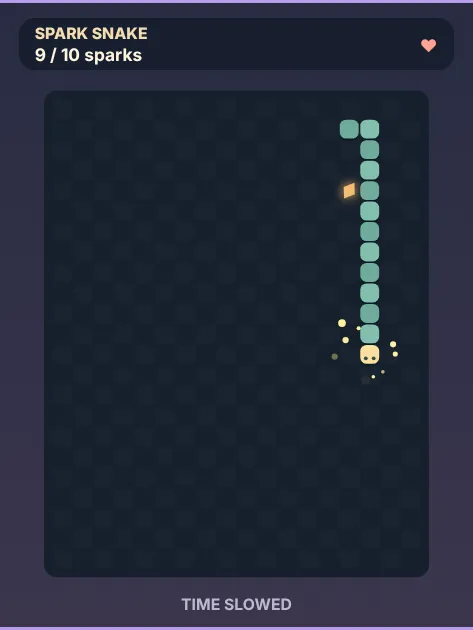
In the figure the snake has grown to 13 segments, its head points down, and the spark sits on the left side of its body, higher up. You get there by turning left, then up: two turns in a row. With Slow on, you can enter both comfortably.
Frequently asked questions
How do you get a high score in a snake game?
You manage space more than speed: stay away from edges and corners, think about your exit before you take the food, and fold your body row by row once you’re long. In Spark Snake, finishing a level in under 30 seconds also earns a bonus.
Can the snake move onto the square its tail occupies?
That varies between versions. In Spark Snake you can step onto the square your tail is leaving, but not on the step where you eat, because the tail stays put.
Can the snake go through walls in a snake game?
It depends on the version: in some the snake leaves one edge and re-enters from the opposite one, in others walls kill too. In Spark Snake you can’t pass through a wall; hitting one ends the run.
How long does Slow last in Spark Snake?
It slows time for 2 seconds and is ready again 6 seconds after use. The level clock keeps running, so use it sparingly if you’re chasing the time bonus.
Games related to this guide

Star Barrier
Hold the line in the sky.
1–2 min · Play free
Meteor Sweep
Clear a path across the sky.
1–2 min · Play free
Neon Current
Catch the rhythm of the night.
1–2 min · Play free