
How to Play Solitaire: Rules, Your First Deal and Tips
In solitaire, also called patience, you play alone and move every card onto 4 foundation piles, each built by suit from ace to king. You build 7 columns downward in alternating colors (red, black, red…), turning up the face-down cards beneath, and draw from the deck when you run out of moves. Below you’ll find the rules, what to look for in your first deal and a few tips.
Published
Rules: 7 Columns, 4 Foundations, 1 Deck
The most common version is often called Klondike. It’s played alone with a standard 52-card deck. Of those cards, 28 go into the 7 columns: the first gets 1 card, the seventh gets 7, and only the top card of each column is face up. The other 24 cards wait in the face-down deck.
- Columns: Build in descending order, alternating colors: a black 5 goes on a red 6. You can move a face-up run in one move; only the run’s highest-value card has to fit the new spot. When a column’s top card leaves, the face-down card under it turns face up.
- Foundations: Each suit builds on its own foundation from ace to king. Only 1 card at a time goes to a foundation.
- Empty column: Only a king goes into an empty column, and so does any run that starts with a king.
- Deck: Draw a card. If it fits a column or a foundation, place it there; if not, it waits in the face-up pile. When the deck runs out, flip the pile over and draw again.
Rules differ on how many cards you draw and how often you can go through the deck: some games draw 3 at a time and limit the passes, others draw 1 with no limit. Know your rules before you start.
You win when all 4 foundations reach the king. If no move makes progress, you’re stuck, and some random deals can’t be won at all.
What to Look for in Your First Deal
When the cards are dealt, don’t rush. Scan the table once and ask 3 questions: Which card can go to a foundation? Which column hides the most face-down cards? Which move turns one up?
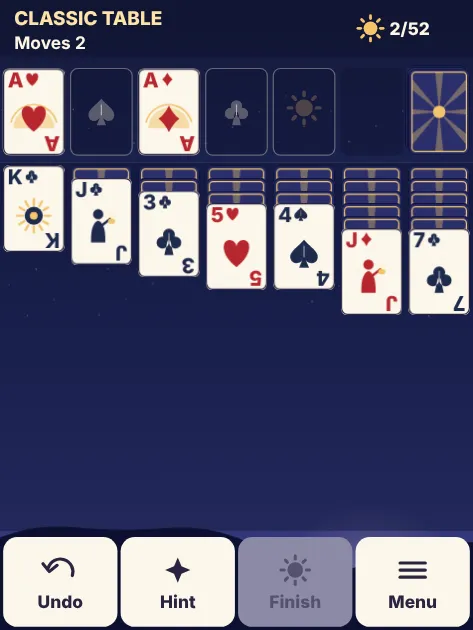
Here, a lone king sits in the leftmost column and each of the 2 rightmost columns hides 5 face-down cards. Now let’s apply those questions in four steps.
- Send aces and twos to the foundations. Nothing goes on an ace in the columns, and only an ace goes on a 2, so sending them costs you no options. Here, the ace of hearts and the ace of diamonds are already on their foundations.
- Pick the move that turns a face-down card up. Between 2 moves, play the one that turns a card up: a new card brings new options. Most face-down cards are in the right-hand columns, so the real work is there.
- Don’t empty a column without a king. Only a king goes into an empty column. If you can’t see a king to move, don’t rush to clear one. Moving the left-hand king is pointless too: nothing is face down under it, and there’s no empty column to go to.
- Think of a run as one piece. Look for a spot where you can move a face-up run whole; you can often reach the face-down card beneath it only that way.
Strategy and Tips
Good solitaire means seeing what a move will turn up before you make it. Four habits help:
- Favor the column with the most face-down cards. At the start, 6 face-down cards lie under the rightmost column’s top card. The more a column hides, the more new cards and options appear as you uncover it.
- Don’t rush to the foundations. A card on a foundation can’t carry anything in the columns: with a red 6 on its foundation, you can’t put a black 5 on it. In Dawn Deck you can move a foundation’s top card back to a column, but it counts as a move. Sending a card other than an ace or a 2 is safe once the two opposite-color foundations have reached the rank just below that card. Example: for a red 6, the spade and club foundations should be at 5 or higher.
- Play the table first, then the deck. If a table move makes progress, make it before you draw. The deck is your backup.
- Don’t flip the deck blindly. When you draw 1 card at a time, the deck comes in the same order on every pass unless you take cards from it. Track which card shows up when.
If you get stuck, review your last moves: a card sent to a foundation too early, or a column emptied with no king to put in it, can cost you the game. When you start a new hand, run through these four habits in order. We cover helpers specific to Dawn Deck, such as the Dawn Breeze, in the differences section.
How Dawn Deck Differs from Classic Solitaire
Dawn Deck adapts the classic table to short breaks. What it has and what it doesn’t:
- It starts small. The 24 levels of the Dawn Road grow the table gradually: level 1 opens with a table of 4 columns and cards from ace to 5, and the game reaches 7 columns by level 7 and the full 52-card deck by level 9.
- A turned card stays turned. On the Dawn Road and in Today’s Hand, once you turn a face-down card up, undo can’t go back past that point (Today’s Hand is a single hand that changes every day). The Classic Table has no such limit and no Dawn Breeze: you play by the classic rules, and undo goes back up to 600 moves.
- The Dawn Breeze. On the Dawn Road and in Today’s Hand, every hand starts with 1 Dawn Breeze; you earn another for every 4 cards you send to the foundations, and you can hold up to 2. Tap the sun in the top row or the Dawn Breeze button, then pick a column whose lone face-up card sits on face-down cards: the card goes to the very bottom of the deck and the card under it turns face up. This counts as 1 move. It’s first taught in level 4.
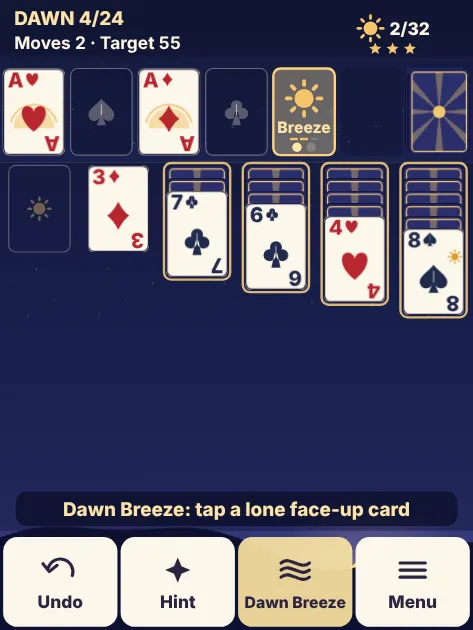
- Help. Safe auto-send moves only aces and twos to the foundations; you can turn it off in the menu. The Finish button lights up once every face-down card is open. A hint costs stars: if you use one, you earn at most 2 stars on that level.
- What’s missing: Dawn Deck draws 1 card at a time. There’s no 3-card draw, no Spider and no FreeCell.
Frequently asked questions
Is solitaire the same as patience?
Yes. “Solitaire” is the usual name in American English and “patience” is common in British English; both are general names for 1-player card games. This guide covers the most common version, the 7-column table. Spider and FreeCell follow different rules.
What card goes in an empty column?
Only a king, or a run that starts with a king. On Dawn Deck’s short tables, the highest card of that table, the one with a sun, takes the king’s place: a 5 in level 1 and a jack in level 7.
How many cards do you draw, and how many times can you go through the deck?
It depends on the rules. Some games draw 3 cards at a time and limit the passes; others draw 1 with no limit. Dawn Deck draws 1 card and does not limit passes through the deck.
Can every deal be won?
No. Some random deals can’t be won with any sequence of moves. In Dawn Deck, the Classic Table (960 hands) and Today’s Hand (366 hands) are drawn from hands verified to be winnable, and every Dawn Road level has a Target: a move count at which the hand is known to be won.
Games related to this guide

Shape Pairs
Make room in your mind.
3–5 min · Play free
Foam & Syrup
Foam on top, syrup below; one color per bottle.
10–90 sec per level · Play free