
How to Play a Card Matching Game: Rules and Tips to Remember
In a card matching game, the cards lie face down on a table and you flip two per move. If the pictures are the same, you’ve found a pair; if not, the cards turn back over. The goal is to find every pair in as few moves as you can. Below are the rules, ways to remember where cards are, and how Shape Pairs differs from the classic game.
Published
Rules: two cards, one move
The table is full of cards with their pictures facing down. Every picture has exactly one match somewhere on the table, and the goal is to find all the matches.
- A move: You flip two cards, one after the other. If the two pictures are the same, you’ve found a pair; the cards stay face up or leave the table.
- A wrong pair: If the pictures differ, the two cards turn back over after a short moment. In that moment you memorize what you saw.
- With two players: If you play at one table, a player who finds a pair goes again; a miss passes the turn. Most pairs wins.
- Playing alone: In solo versions the measure is the number of moves or the time; fewer moves is better.
- Number of cards: Table size varies by version; the more pairs, the less luck and the more method counts.
- Luck and memory: The first flips are luck; as you see more cards, the game becomes a memory task.
The first six moves: what to flip, what to remember
On the 4×4 table shown, six moves have been played and two pairs are found (the moon and the flower). The heart and the leaf are face up but don’t match; the game reminds you with “Remember these two…”.
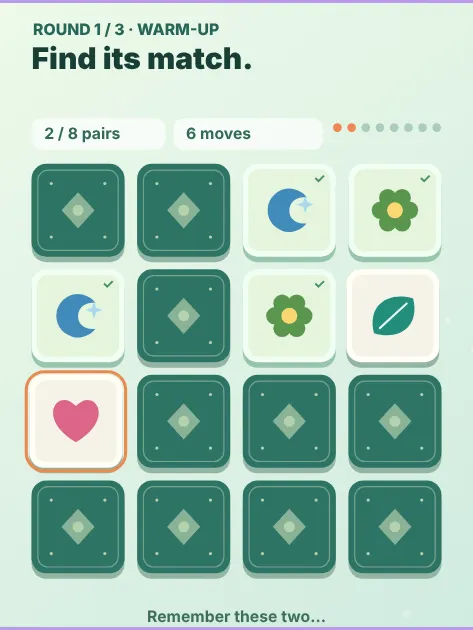
You now know where the heart and the leaf are, and you can use both next move. You haven’t seen the match for either yet, so you start with a card you’ve never flipped. If it turns out to be a heart or a leaf, you flip its partner at once and take the pair. If not, you pick the second card from the unseen ones too, because flipping a card you already know teaches you nothing new. Played this way, every move gives you either a pair or new information.
Ways to remember where the cards are
- Take a known pair right away. If you’ve seen both spots of a picture, flip that pair without doing anything else; holding on to information only risks forgetting it.
- Pick the first card from the unknowns. Start the move with a card you’ve never seen. A new picture teaches you something, and may match a card whose partner you already know.
- Pick the second card from the unknowns too. If you don’t know the first card’s partner, don’t flip a card you already know as the second: that card can’t be the partner, because if it were, you’d already know. An unknown card speeds up learning the table.
- Name the card and tie it to its place. A phrase like “heart top left, leaf second row” holds picture and position together. A little story among the pictures (heart next to the leaf, moon above the flower) is easier than memorizing each one.
- Split the table into regions. Think in small pieces, such as corners or rows, and after each move add only what you’ve just seen.
- Learn from the wrong pair. Both cards of a miss are information: keep their pictures and places in mind as carefully as a pair you found. Keep your eyes on them as they turn over.
- Hold little in mind. You can’t remember everything at once, so taking known pairs right away saves moves and frees your memory too.
- Flip systematically. Flipping unknown cards in reading order makes it easy to track which you’ve never seen.
- Know your move budget. In the limited rounds, work out how many wrong moves you can afford: round 2 of Shape Pairs has 10 pairs and 28 moves, so at most 18 wrong moves; round 3 has 15 pairs and 42 moves, so 27.
These methods help you find the cards in fewer moves in this game. We make no claim that the game improves memory in general.
How Shape Pairs differs from the classic
Shape Pairs pairs colorful shapes instead of pictures and is played in three rounds:
- Three tables. Round 1 is a 4×4 warm-up with no move limit. Round 2 gives you 28 moves on a 4×5 table, and round 3 gives you 42 moves on a 5×6 table.
- Counting moves. Flipping two cards is one move; tapping a card that’s already face up doesn’t count as a move.
- A wrong pair. A wrong pair stays face up for about 0.95 seconds, then turns back over; you can’t flip another card in that time.
- Two of each shape. The table holds exactly two cards of each shape, and it’s reshuffled every round; what you learned in the previous round is no use on the new table.
- Scoring. Every pair is worth 120 points, and pairs found in a row add a streak bonus; a wrong pair costs 10 points. In the limited rounds, you get 25 points per unused move at the end of the round, so the move budget is a source of points as well as a limit.
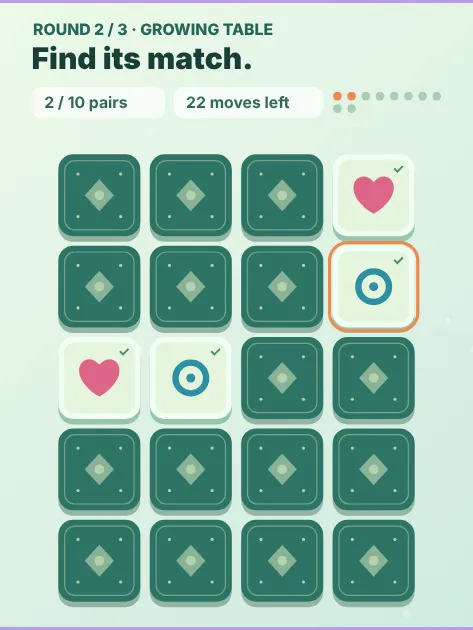
In the figure you’re in round 2: there are 10 pairs on the 4×5 table, six moves have been played, two pairs are found and 22 moves are left.
Frequently asked questions
Which card should you flip first in a card matching game?
The first flips are luck; one card is as good as another. What matters is that afterwards you always flip cards you haven’t seen before, and take a pair right away whenever a picture with a known partner shows up.
How do you remember cards in a matching game?
Naming the card and tying it to its place, splitting the table into regions and flipping unknown cards systematically all help. These are methods that work in the game; we don’t claim the game improves memory in general.
How many moves do I get in Shape Pairs?
Round 1 has no move limit. In round 2 you get 28 moves for the 4×5 table, and in round 3 you get 42 moves for the 5×6 table. Flipping two cards counts as one move.
How long does a wrong pair stay face up in Shape Pairs?
About 0.95 seconds. The cards turn back over on their own at the end of that time, and you can’t flip a third card meanwhile, so look at both cards carefully and keep them in mind.
Games related to this guide
Number Orchard
Small numbers grow.
No time limit · Play free
Lamp Garden
Switch off, light up, find the shortest way.
2–5 min · Play free
Foam & Syrup
Foam on top, syrup below; one color per bottle.
10–90 sec per level · Play free