
How to Solve Box-Pushing Puzzles: Tips to Avoid Deadlocks
In a box-pushing puzzle (also known as Sokoban) you steer a worker and push every crate in the warehouse onto the marked goal squares. You can only push, never pull, so the real work is planning so that no crate ends up in a corner or against an edge you can’t rescue it from. Below are the rules, how to recognize a deadlock, solving tips and how Crate Route differs from the classic game.
Published
Rules: you can only push
The warehouse is a grid enclosed by walls, with a worker, a few crates and marked goal squares. The goal is to settle every crate onto a goal.
- Moving: The worker moves one square up, down, left or right per step; no diagonals.
- Pushing: If the worker walks into a crate, the crate is pushed one square ahead. You can only push, never pull the crate.
- Obstacles: If there’s a wall or another crate behind the crate, it won’t move. You can’t push two crates in a row.
- Finishing: The level ends when every crate sits on a goal. There are as many goals as crates.
- Worker on a goal: The worker can stand on a goal square too; the level ends once the crates are in place.
- Scoring: Most versions judge steps and pushes; fewer is better.
How a deadlock happens: one crate into a corner
In level 1 shown there’s one crate and one goal. The solution is very short: three steps to the right and the crate sits on the goal; even the 3-star limit is only 5 steps. But in the figure the worker pushed the crate down, then left, into the bottom left corner. Both of its sides are walls, so it can no longer be pushed anywhere; the screen shows “A crate’s stuck in a corner · Undo”.
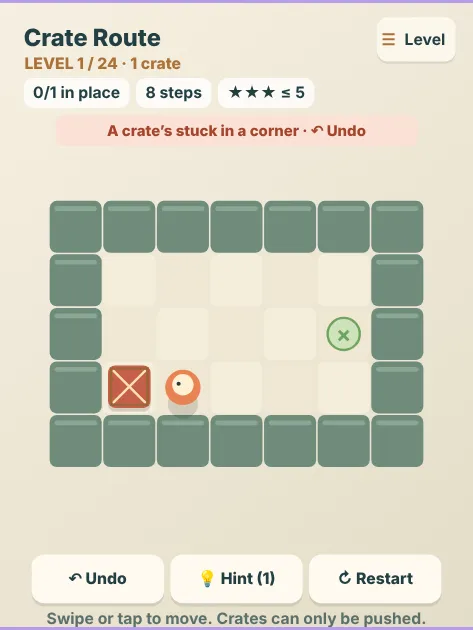
The lesson has two parts. First: a corner without a goal is a dead square, and once a crate enters it the level can’t be solved. Second: you can only push a crate from behind, and a cornered crate has a wall behind it. So before every push, check where the crate is going and whether it can get out. One wrong push can make even a small level unsolvable; trying is free, and undo is easy.
Solving tips
- Think backwards from the goals. Find the last push that brings a crate onto a goal, work out where the worker must stand for it, and carry that back step by step.
- Learn the dead squares. Corners without a goal are dead squares. A crate against a wall can only slide along that wall too; if there’s no goal on that wall, the crate is stuck there.
- Don’t leave two crates side by side against a wall. If two crates touch each other along a wall, neither can move; unless they’re on goals, the level is a dead end.
- Fill the dead-end goal first. The way to a goal at the back of the room can close once the goals before it fill up; fill the farthest goal first and the one nearest the entrance last.
- Place the crate that blocks the way first. If a crate blocks the worker or another crate, settle it first. Plan from the start which crate goes to which goal.
- Leave room to get behind it. Before you push, make sure the worker can walk around the crate and get behind it again; a crate pushed into a narrow corridor often can’t come back.
- Count pushes, not steps. First work out which crate is pushed which way how many times, and add up the walking afterwards. Shortening the walk doesn’t change the pushes, but badly chosen pushes break the solution however you walk.
- Count a crate’s options. If a crate can go to several goals, which one you pick decides the path of the later crates; make that choice up front, not move by move.
- Don’t hesitate to undo. Undo is the tool of trial and error; undoing the moment you see a dead crate beats carrying on down a chain of mistakes.
How Crate Route differs from the classic
Crate Route keeps the classic rules and turns them into a 24-level campaign:
- Verified levels. Every level was generated by an offline search and its shortest solution is on record; the tests replay it with real input. So no level is a dead end from the start; only you can walk into one.
- Corner warning. If a crate that isn’t on a goal goes into a corner, the crate turns red and a warning appears. The game only warns about corner deadlocks: a crate jammed along a wall, or crates locking each other side by side, you must spot yourself.
- Undo. Undo works for up to the last 400 moves and also takes one off the step counter, so experimenting costs no steps.
- Hint. There’s one hint per level; the hint shows the first step the worker should take. If you use the hint, you can earn at most 2 stars.
- Stars depend on steps. Stars depend on steps, not pushes. For 3 stars you have to finish without the hint and with at most 10% more steps than the shortest solution (and at least 2 more steps allowed).
- Walking. Tap a far square and the worker finds the path itself, never through crates. Swiping takes one step too.
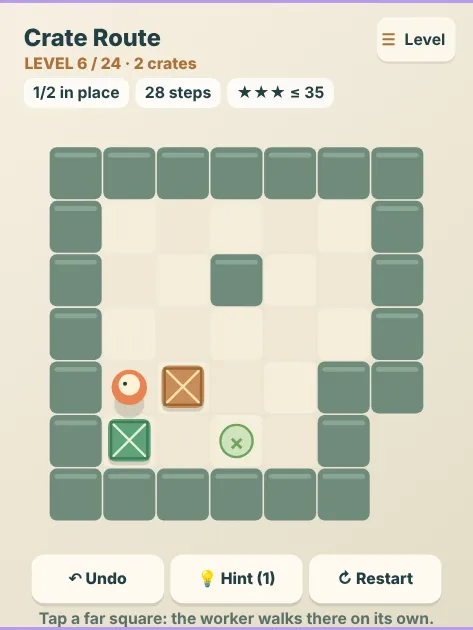
In the figure you’re in level 6 (2 crates, shortest solution 32 steps). After 28 steps one crate sits on its goal (“1/2 in place”), and the top bar shows the 3-star limit as ★★★ ≤ 35. The second crate, still orange, is headed for the goal on the right.
Frequently asked questions
How do you solve a box-pushing puzzle (Sokoban)?
Plan backwards from the goals: which goal each crate goes to and from which direction it’s pushed. Don’t push crates into corners without a goal or along edges, settle the crate that blocks the way first, and undo when you need to.
What do you do if a crate gets stuck in a corner?
If a crate that isn’t on a goal has gone into a corner, you can never get it out; undo or restart the level. In Crate Route the crate turns red and a warning appears in that case.
How many hints can you use in Crate Route?
One per level. The hint shows the first step the worker should take; if a crate is stuck in a corner it gives no hint and tells you to undo first. If you use the hint, you can earn at most 2 stars from the level.
Can crates be pulled?
No, crates can only be pushed. So before pushing a crate, make sure the worker can get behind it and that the crate can get out of the place it’s heading for.
Games related to this guide
Tile Workshop
Use the gap, find the shortest route.
2–5 min · Play free
Lamp Garden
Switch off, light up, find the shortest way.
2–5 min · Play free
Water Circuit
Bring every pipe to life, leave no end open.
2–5 min · Play free